Be yourself; Everyone else is already taken.
— Oscar Wilde.
This is the first post on my new blog. I’m just getting this new blog going, so stay tuned for more. Subscribe below to get notified when I post new updates.
Be yourself; Everyone else is already taken.
— Oscar Wilde.
This is the first post on my new blog. I’m just getting this new blog going, so stay tuned for more. Subscribe below to get notified when I post new updates.
Human capital has become an important aspect of economic in growth in local and national economies. It being the measure of health and education influences the economic outcome. Economic growth depends on the technological advancements which in turn depends on the growth of the human capital.
In the international ranking of Human Capital Index by the world bank, India ranks at 115 out of 157 countries. India ranks lower than most of the South Asian countries, even below Nepal and Bangladesh which are poorer nations, in terms of per capita income, than India.
The Human Capital Index given by the world bank was not accepted by the Indian government because according to them education and health are not the only factors to determine the growth of human capital. They also felt that their research methodology was biased. Critics say that the human capital index has reduced the working people to mere commodities and education as means for economic prosperity. But the actual quality of education is determined by research and evidence.
But there is obviously some ground truth in the findings of the index by the World Bank. There is no index that is completely satisfactory but this one covers the major components of Human Capital . There is still a long way to go for the Human Capital Development of India.
The main components of the human capital are education, health and survival. The first aspect is education. Since HCI places a lot of attention on quality of education we have got a dismal image in India. Only around 76 percent children are admitted into a school. According to the census conducted,14 percent of men aged between 25-35 years have only studied till 10th grade,11.5 percent have only finished till 12th grade. Women’s statistics are even worse,10 percent dropped out after class 10, 8 percent after class 12. Only 11 percent were graduates. The annual education report 2017 states that 25 percent of the rural students cannot even read basic text of their own language. Fifty percent are not able to divide three-digit numbers by one digit. The schooling years is only of five years even though the Right to Education Act 2009 promises eight years of compulsory education. The total expected years of schooling is of ten years compared to the developed countries which exceeds more than 12 years of school. India has the second lowest score for education among the South Asian countries.
The second aspect is survival and health. The probability of survival in India till age 5 is 96 percent. According to the statistics, three out of hundred children are stunted and are at a risk of cognitive and physical disabilities. In India,83 percent of 15-20 years old will survive until age 60. The statistics say that a child in India will be only 44 percent productive after receiving full education and health. India has the lowest health score among the South Asian countries. Diseases like stunting, anemia, cognitive impairments, hearing, vision loss, HIV, AIDS, Malaria and Tuberculosis which are prevalent in India impact the learning and productivity of people. Countries like Nepal, Pakistan and Afghanistan have better health scores than India even though they have low per capita income.
There has been various policies and schemes that has been started by the government to improve the education and health sector in India. The Samigra Shiksha Abhiyaan has been started to provide education and opportunities to the 147 million underprivileged children. And the Ayushman Bharat Programme which is the world’s largest health initiative has provided 500 million citizens with health coverage. Sanitation coverage has increased from 38 percent in 2014 to 83 percent in 2018 under Swach Bharat Mission. They have built almost 70 million toilets in four years. The Pradhan Mantri Ujjwala Yojana provided LPG connections to women to reduce the health problems caused by burning of coal and wood. But India’s human capital index is still disappointing.
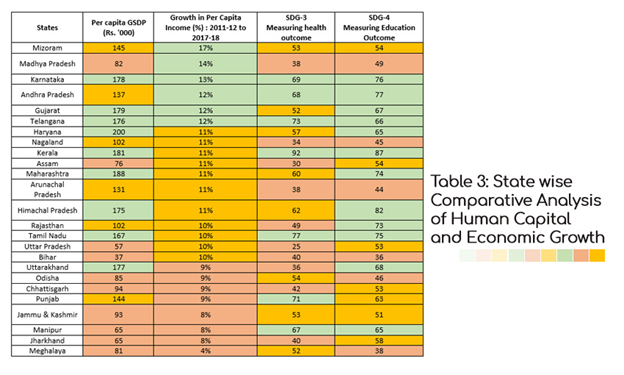
Economic growth does not always lead to human capital growth. The relation between increase in per capita income and investment in education and health is analyzed in the chart below which shows the gap in the conversion of economic growth into education and health growth for the states. For example, Maharashtra saw a growth of 14 percent contribution to the overall GDP. But despite having growth in income their sustainable goals are at the lowest. On the other hand, if you take Kerala, Telangana or even Mizoram, their economic growth and their sustainable development goals have increased. These are the states which invest in their human capital the most.
India is under-investing in major sectors which contribute to GDP growth that is education and health. Since India has the largest youth population and can benefit from an economic dividend, lack of investment in education would result in this wonderful opportunity being wasted.
The nations that are not investing enough in health and education are at a risk of stagnation and low per capita GDP. “Investing in people rather than primarily in infrastructure is the best way to achieve sustainable development, and investments in human capital through health and education offer compelling returns,” said Tedros Adhanom Ghebreyesus, WHO Director-General.
The public health expenditure of India is one of the lowest in the world at 1.02 percent of GDP compared to the 5 percent recommended by experts. Even spending on Education is low in India at 2.7 percent in 2018 in comparison to 3.3 percent in China or 5 percent in Mauritius. India spends more on Military than education. In 2016, Stockholm International Peace Research Institute states that India is the World’s largest Military spender in 2016. There is no point of being a powerful military country if the human capital of that country is suffering.
The situation in which Indians grew up in is completely different than that of the other developed countries in the world. From social inequality to discrimination, Indians have faced it all and are in fact facing it till now. Education and health are the only way to achieve the optimum state of human capital. And considering the fact that India has the world’s largest youth population, it would accomplish a lot in terms of economic growth. To be in par with the global economy in terms of talent, opportunity, innovation, India has to focus on bringing educational reforms that make an impact, improve the socio-economic conditions and come up with a better healthcare solution which incorporates primary healthcare as well.
References
Biswas, A. K., & Hartley, K. (2015, June 22). India’s Lagging Human Capital. Retrieved from https://thediplomat.com/2015/06/indias-lagging-human-capital/
Human Capital & Economic Growth in India. (2019, February 12). Retrieved from http://www.marketexpress.in/2019/02/human-capital-economic-growth-in-india.html
Ranked below Nepal, Bangladesh, India rejects World Bank’s Human Capital Index. (2018, October 12). Retrieved from https://www.dnaindia.com/india/report-ranked-below-nepal-bangladesh-india-rejects-world-bank-s-human-capital-index-2674513
Sengupta, J. (n.d.). India’s poor HCI ranking: A warning, not an insult. Retrieved from https://www.orfonline.org/expert-speak/indias-poor-hci-ranking-a-warning-not-an-insult-45493/
This is an example post, originally published as part of Blogging University. Enroll in one of our ten programs, and start your blog right.
You’re going to publish a post today. Don’t worry about how your blog looks. Don’t worry if you haven’t given it a name yet, or you’re feeling overwhelmed. Just click the “New Post” button, and tell us why you’re here.
Why do this?
The post can be short or long, a personal intro to your life or a bloggy mission statement, a manifesto for the future or a simple outline of your the types of things you hope to publish.
To help you get started, here are a few questions:
You’re not locked into any of this; one of the wonderful things about blogs is how they constantly evolve as we learn, grow, and interact with one another — but it’s good to know where and why you started, and articulating your goals may just give you a few other post ideas.
Can’t think how to get started? Just write the first thing that pops into your head. Anne Lamott, author of a book on writing we love, says that you need to give yourself permission to write a “crappy first draft”. Anne makes a great point — just start writing, and worry about editing it later.
When you’re ready to publish, give your post three to five tags that describe your blog’s focus — writing, photography, fiction, parenting, food, cars, movies, sports, whatever. These tags will help others who care about your topics find you in the Reader. Make sure one of the tags is “zerotohero,” so other new bloggers can find you, too.

 Human capital and Economic growth in India